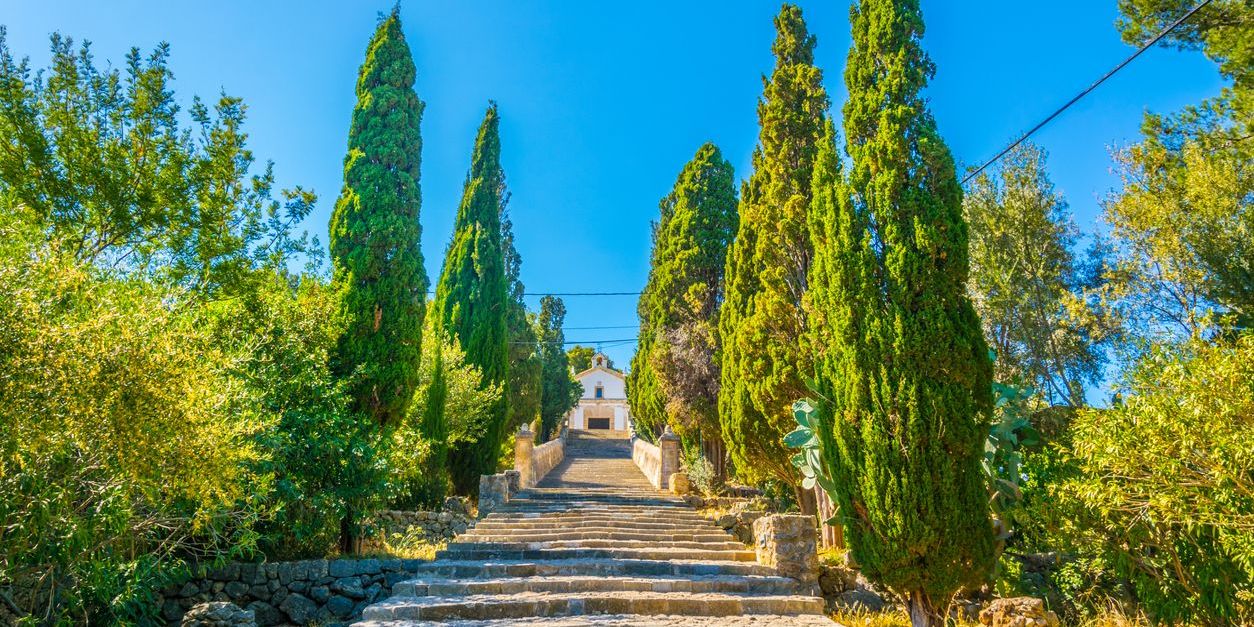
They say the hardest paths lead to the most amazing destinations. Something like that happens with El Calvari de Pollença, an imposing stone staircase carved into the rock that ascends to the top of the hill.

It’s a path that poses a challenge, we’re not going to lie to you, but it has its rewards.

If you’re in Pollença or thinking about coming to spend your holidays here and haven’t climbed the Calvari de Pollença yet, this is what you need to know.

Table of Content

What is the Calvari de Pollença like?

In the center of Pollença there’s a stone staircase that climbs—and how—to the top of a hill. In total there are 365 steps, flanked by centuries-old cypress trees and fourteen crosses three meters high.

Once at the top, you’ll come across a chapel and unbeatable views. Do they justify the effort of climbing the nearly 400 steps? Let us argue why it’s definitely worth making the effort.

El Calvari is probably the most photographed place in Pollença and, at the same time, one of the hardest to describe and reach.

Calvari-de-Pollenca.jpg

The History of the 365 Steps

The hill we now know as El Calvari de Pollença originally belonged to the Templars, who used it as a watchtower to warn of pirate attacks that besieged the coast of Mallorca in the Middle Ages, which were not few.

Not much remains from that era, but the strategic position of this hill is more than evident.

The staircase that climbs to its summit was built between the late 19th and early 20th centuries, although the oratory that crowns it dates from the late 18th century.

The 365 steps —one for each day of the year—are surrounded by fourteen crosses that represent the stations of the Way of the Cross, recalling the path that, according to Christian tradition, Jesus Christ walked to Mount Golgotha. It all makes sense, hence the name of the place!

The Steps

The staircase is made of irregular stone, steep and without intermediate landings. It’s not a particularly demanding climb, but not easy either; let’s say you need to be in good physical shape to reach the very top without stopping to catch your breath.

Calvari-de-Pollenca-escalones.jpg

When and How to Climb

In summer we recommend you make the climb in the morning; otherwise, in the afternoon the sun will hit you head-on and make the ascent more difficult. The stairs begin in the center of town, next to the Church of the Virgin of the Angels, in Plaça de l’Almoina.

And if you don’t want to climb on foot—which is the way to do it!—you can also ascend by an alternative road by car; it’s designed so that people with reduced mobility or those with children can also access the hill, but the real charm is in getting there by your own means.

You can also visit the Calvari, which is free and has no restricted hours, at any time of day, including at dusk, when the town is covered in particularly beautiful light.

What You'll Find at the Summit

The chapel that crowns the Calvari was built in the late 18th century; known as the Oratory, it has an elliptical floor plan and semicircular apse. And although what you see today largely reflects a restoration done in the sixties, the interior preserves a piece that has been there since its beginnings: a 14th-century sculptural group depicting Jesus Christ with the Virgin Mary at his feet. It’s a carving of incalculable value.

Besides this, the views from the summit are 360°. You’ll be able to admire all of Pollença along with the Tramuntana Mountains, the Mediterranean, and also Cape Formentor, all in one!

Traditions That Remain on Mount Calvario

The most important tradition of the Calvari is the Davallament —the Descent on Good Friday—one of the most striking Holy Week events on the entire island and, those who have experienced it confirm this. It’s a moment that’s hard to forget.

The ceremony begins at dusk when an articulated carving of Christ from the 14th century is removed from the cross at the top of the Oratory and descends in procession down each and every one of the steps to the Church of the Virgin of the Angels.

The most magical part of this moment, besides the emotion experienced by those carrying the Christ, are the hundreds of torches carried by the different brotherhoods to light his way.

If you’re in Pollença during Holy Week, there’s no excuse not to come see such a spectacle.

The rest of the year the Calvari de Pollença is visited by tourists, yes, but also by townspeople who regularly climb up to disconnect and enjoy the peace.

Calvari-Pollenca.jpg

What Else to See in Pollença

After or before visiting the Calvari, you have to explore the rest of Pollença.

Plaça Major is the center of gravity of the town, where on Sundays you’ll also come across a market full of fruits, vegetables, flowers, and typical Mallorcan products.

And just a step from this emblematic square—which all us locals are very fond of—is the Convent of Santo Domingo, built by the Dominicans between the 16th and 17th centuries.

The Roman Bridge of Pollença is another stop you must make to take home a memory in the form of a photograph. It’s on the outskirts of the old town and is much prettier in the mornings, when the light hits it from its best angle.

And if you have time, take a trip to Cape Formentor. The road that reaches the lighthouse—inaugurated in 1863—has views of the cliffs and the sea that are, without a doubt, among the most spectacular in all of Mallorca. While you’re here you can’t miss the opportunity to enjoy the beach of Port de Pollença.

Book Your Visit to Pollença

El Calvari is one of those visits that generates a love-hate feeling, because of the effort to reach the summit and because of the enormous gratification the views offer. For us it’s more than worth it. Will you climb up and tell us how your experience was?

Oh! And after the sacrifice, don’t hesitate, rest easy by booking one of the accommodations we have at Ideal Property. 365 steps later, you deserve it.