



Petra is a village of barely 2,700 inhabitants that, unlike other towns in Mallorca, does not double or triple its population in summer due to the influx of tourists. In other words, people pass by when they see the sign that says “Petra.”
Well, that’s their loss, because they are missing out on one of the most authentic villages on the island, and, as the popular saying goes, if a small village has such a large church — like Petra’s — it’s because in its time it was one of the richest and most important places in Mallorca.
And that’s precisely what we’re here to tell you about today: its church!
The church you can find today in the center of Petra has undergone many transformations, but its origins date back to the 13th century. That’s right! Construction of the current temple began in 1582 and, as was common with almost all large Mallorcan churches, it stretched over entire generations until well into the 17th century.
And of course, there’s a milestone that has made it very beloved among Mallorcans: on November 24, 1713, a certain Miquel Josep Serra i Ferrer was baptized in its baptismal font. That child would eventually become Friar Junípero Serra, the friar who crossed the Atlantic and ended up founding cities like San Francisco and Los Angeles. Not bad at all, right?
Furthermore, the font itself is very beautiful; it was carved by Miquel Abraham and Joan Antic in 1588, with a very distinctive octagonal shape.
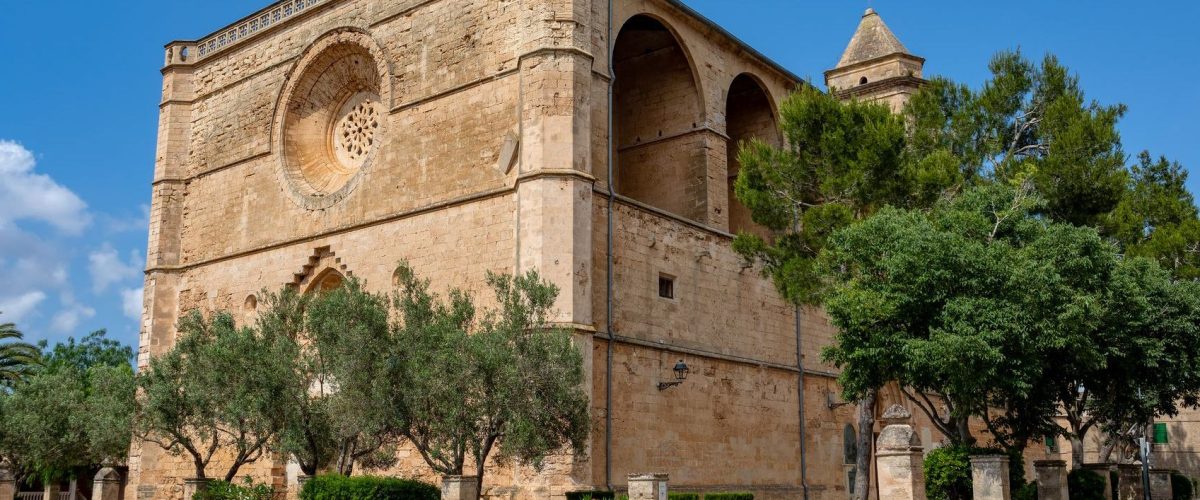
Sant Pere was built during the Renaissance and Baroque periods, but its architecture strictly follows the Gothic tradition. It didn’t follow trends. And this wasn’t considered strange among the inhabitants of Petra at the time, because large parishes almost carried Gothic as their hallmark.
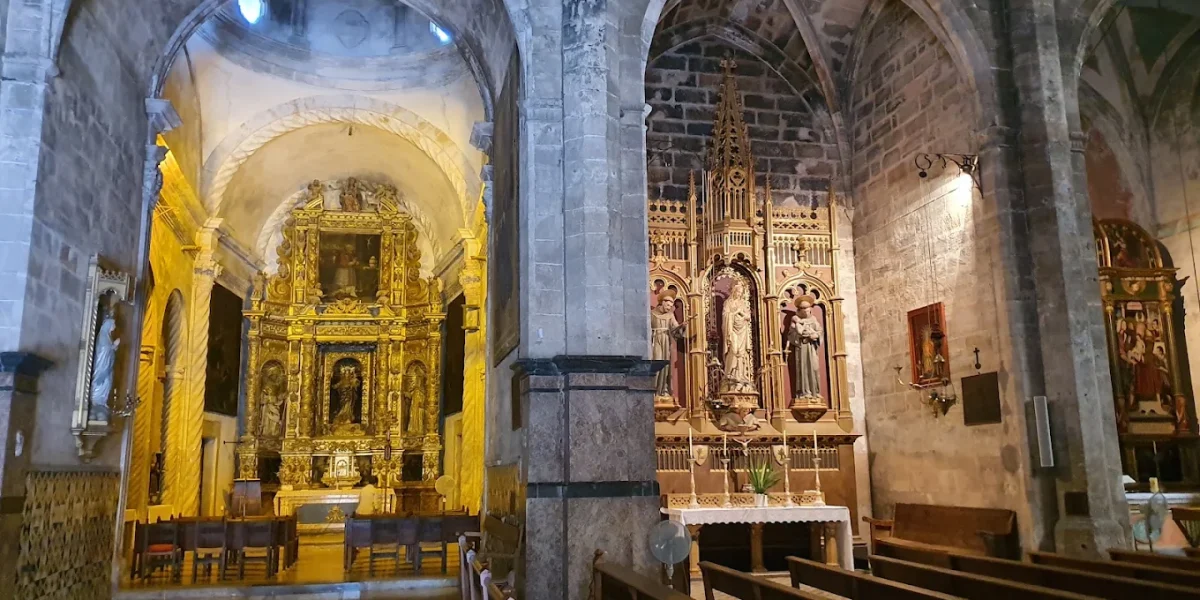
The result is a single-nave church, with side chapels and ribbed vaults full of details. However, it’s not entirely Gothic: it has a Renaissance portal in the sacristy and the Chapel of the Roser, which is Baroque. A little variety never hurts.
The main facade features a large openwork rose window, a main portal flanked by volumes that emulate octagonal towers, and, to one side, a bell tower over 30 meters high, divided into several sections and topped by an elegant stone balustrade.
Upon crossing the church door, the first thing that strikes you are its proportions — in case we haven’t mentioned it, Sant Pere is one of the largest churches in Mallorca. The dimensions of the building are so vast that it’s hard to believe it’s located in a small village like Petra.
In the nave, you’ll find a multitude of stained-glass windows that let natural light into the temple, filling it with colors, and several elements you should pay attention to. One of them is the baptismal font we’ve already told you about, but there’s more:
The church is located at Plaza de la Rectoria number 2, admission is free, and its usual opening hours are Monday to Saturday, from 10:30 AM to 12:00 PM, except in August when it is closed.
In addition to visiting hours, you can also attend a mass. They usually officiate one daily — in winter at 7:00 PM and in summer at 8:00 PM — and an extra one on Sunday. Sunday ceremonies are at 9:30 AM in winter and 11:30 AM in summer.
However, before you go, it’s a good idea to call 971 561 017 to confirm it’s open that day.
No excuses! We’ve just introduced you to one of Mallorca’s largest — and most beautiful — churches, which also has a baptismal font that gave its name to the Franciscan friar who ended up being canonized as a saint.
That alone should make you want to come to Petra, but the rest of the village is also beautiful and very peaceful: it boasts the house museum where Friar Junípero Serra was born and the Convent of San Bernardino, a 17th-century Franciscan complex with a stunning cloister.
Not to mention that very close by is the Ermita de Bonany, another spectacular religious building that also serves as a viewpoint due to its location over 300 meters high, and a stone’s throw away are other towns like Sant Joan or Manacor, which houses the beloved museum dedicated to Mallorcan tennis player Rafa Nadal.
The route is almost planned; all you need to do is click here and book your accommodation with Ideal Property to thoroughly explore the interior of Mallorca.